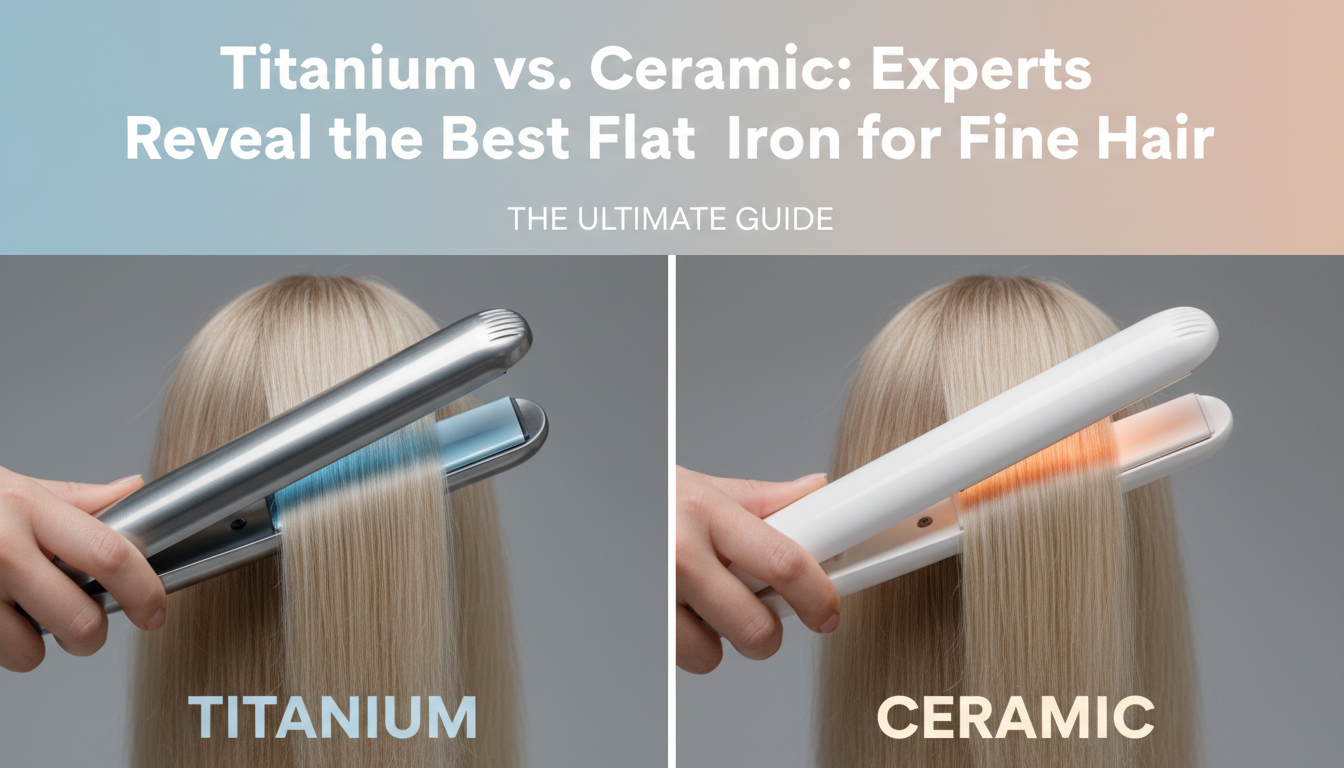
Choosing a flat iron for fine hair feels like a high-stakes gamble. On one hand, you want sleek, frizz-free results; on the other, you are well aware that fine hair is exceptionally prone to heat damage, breakage, and that dreaded limp, “fried” appearance. The debate between titanium and ceramic plates is central to this struggle.
While both materials can technically straighten your hair, they interact with the delicate protein structure of fine strands in very different ways. To help you avoid unnecessary damage, we’ve consulted with hair care experts to break down the science behind these tools and reveal which one truly deserves a place in your styling routine.


Understanding Fine Hair Care and Heat Sensitivity
Before diving into plate materials, it is vital to distinguish between “fine” and “thin” hair. Fine hair refers to the diameter of the individual hair shaft. If your hair feels like silk or thread, you likely have fine hair. Because the diameter is small, the protective outer layer (the cuticle) is thinner, meaning the inner core (the cortex) is more vulnerable to high temperatures.
When you apply too much heat to fine hair, the moisture inside the shaft evaporates too quickly, leading to “bubble hair” or permanent structural damage. This is why the choice between ceramic and titanium isn’t just about aesthetics—it’s about hair health.
Ceramic Flat Irons: The Gold Standard for Fine Hair Care
Most professional stylists recommend ceramic flat irons for individuals with fine or fragile hair. Ceramic is a non-metallic material that conducts heat evenly and gently.
How Ceramic Works
Ceramic plates utilize far-infrared heat. This type of heat penetrates the hair shaft from the inside out, rather than scorching the surface. This “gentle” approach is crucial for fine hair because it preserves the natural moisture balance of the strand while still providing enough heat to change the hair’s shape.
Key Benefits for Fine Strands
- Even Heat Distribution: Ceramic plates are known for eliminating “hot spots,” which are areas on the plate that get hotter than the rest. Hot spots are the primary cause of localized singeing on fine hair.
- Ionic Technology: Most modern ceramic irons produce negative ions that help seal the hair cuticle, reducing frizz and adding shine without needing excessive heat.
- Consistent Temperature: Ceramic holds heat well, meaning you don’t have to keep bumping up the temperature to get a smooth pass.
Titanium Flat Irons: High Performance with High Risk
Titanium is a lustrous transition metal known for its strength and incredible heat conductivity. In the world of flat irons, titanium is the “Formula 1” engine—fast, powerful, and highly efficient.
How Titanium Works
Unlike ceramic, titanium heats up almost instantly and transfers heat to the hair surface with extreme speed. It relies on conduction heat, which affects the surface of the hair immediately. It also produces a high output of negative ions, which is excellent for battling stubborn frizz.
The Risk for Fine Hair Care
Because titanium transfers heat so aggressively, it is very easy to over-style fine hair. A titanium iron set to 350°F can feel much “hotter” to the hair than a ceramic iron at the same temperature. For professional stylists who work quickly, titanium is a time-saver. For the average user at home with fine hair, it can lead to accidental breakage if the iron is held in one place for even a second too long.
Titanium vs. Ceramic: A Side-by-Side Comparison
To help you visualize the differences, here is how these two materials stack up specifically for fine hair types:
| Feature | Ceramic Plates | Titanium Plates |
|---|---|---|
| Heat Delivery | Gentle, Far-Infrared (Inside-out) | Rapid, Surface Conduction |
| Heat-Up Time | Slow to Moderate | Nearly Instant |
| Risk of Damage | Low (Ideal for beginners) | Moderate to High |
| Best For | Fine, damaged, or color-treated hair | Thick, coarse, or healthy “stubborn” hair |
| Finish | Soft, smooth, and bouncy | Ultra-sleek and pin-straight |
The Expert Verdict: Which Should You Choose?
If you have fine hair, the experts almost universally recommend Ceramic. The reason is simple: ceramic is more forgiving. It allows for a slight margin of error in your technique without resulting in immediate heat damage.
However, there is one exception. If you have fine hair that is also densely packed (lots of hair that is individually fine) and very resistant to curling or straightening, a high-quality titanium iron with digital temperature control can be used—provided you keep the temperature below 300°F.
Key Features to Look For Regardless of Material
Beyond the plate material, fine-haired individuals should prioritize the following features to ensure the safety of their strands:
1. Precise Digital Temperature Control
Avoid any flat iron that only has “Low, Medium, High” settings. Fine hair should generally be styled between 250°F and 320°F. You need a digital display to ensure you aren’t accidentally hitting 400°F.
2. High-Quality Plate Coating
Beware of “ceramic-coated” irons, which are usually metal plates with a thin layer of ceramic that can peel off. Look for pure ceramic or tourmaline-infused ceramic plates for the smoothest glide.
3. Beveled Edges
Plates with rounded or beveled edges prevent the iron from “snagging” or “crimping” fine hair, which is more susceptible to physical breakage during the pulling motion.
Pros & Cons
Ceramic Flat Irons
- Pros: Even heat distribution; safer for delicate cuticles; adds shine via infrared heat; usually more affordable.
- Cons: Takes longer to heat up; plates can crack if dropped; may require multiple passes on very curly fine hair.
Titanium Flat Irons
- Pros: Lightweight and durable; incredible for eliminating frizz; heats up in seconds; very effective for “one-pass” styling.
- Cons: High risk of scorching fine hair; often more expensive; can be too powerful for daily use on fragile strands.
Frequently Asked Questions
Is titanium or ceramic better for fine, frizzy hair?
For fine hair that is also frizzy, ceramic tourmaline is the best choice. The tourmaline infusion increases the output of negative ions to flatten the cuticle and stop frizz, while the ceramic base ensures the heat remains gentle enough not to cause breakage.
What temperature is safe for straightening fine hair?
Experts recommend staying within the 250°F to 320°F range. Never exceed 350°F on fine hair, as this is the “melting point” where keratin proteins begin to degrade permanently.
Can I use a titanium iron if I have fine hair?
Yes, but with caution. You must use a high-quality heat protectant and ensure the iron is set to a low temperature. Titanium is generally better suited for professional stylists who have the speed and dexterity to prevent the plates from sitting on the hair for too long.
How often should I straighten fine hair?
To maintain hair health, try to limit heat styling to 2–3 times per week. Fine hair needs “rest days” to recover its moisture levels. Always use a protein-rich conditioner to strengthen the hair shaft between styling sessions.
Do ceramic plates wear out?
Pure ceramic plates do not “wear out,” but “ceramic-coated” plates can. Over time, the coating on cheap irons can chip or wear down, exposing the harsh metal underneath. If you see your plates peeling or feel them snagging, it is time to replace the tool.
—
Topic: Titanium vs Ceramic flat iron which is better for fine hair
Tags: #Titanium #Ceramic #Experts #Reveal #Flat #Iron #Fine #Hair Care